Part 1
[The city you live]
1. Where do you live now?
2. What are the reasons you dislike the city?
3. Do you want to live in this city for a long time in the future?
[Clothes]
1. What kind of clothes do you wear at college?
2. Did you like to wear special clothes at parties?
3. Do you think people spend too much on clothes nowadays?
4. Do you think you will change your clothing style when you leave the college
and go back to your hometown?
Part 2
[Event]
Describe an event that changes your life in a good way.
When?
Why?
One additional question:
Are you a person who likes change?
Part 3
[Job]
1. Do you think nowadays people like to change their jobs several times in the
ir lives? Why?
2. Do you think the working environment in Taiwan will get better in the future?


2014年3月2日 星期日
2014年2月26日 星期三
IELTS Task 1 Bar Chart Sample Answer: Oil Consumption
IELTS Task 1 Sample Answer: Oil Consumption

- Bar Chart
- Future Tenses
- Grouping and comparing predictions
Sample IELTS Task 1 Writing Answer
The bar chart compares the thirst for oil (in billions of barrels per day) in selected OECD and non-OECD countries and regions in 1980, 2008 and in 2030. It can clearly be seen that, while global demand for oil has remained, and is expected to remain, stable in the rich world, it will continue rising, in the developing world.Firstly, despite rising slightly from approximately 41 billion barrels per day in 1980 to around 43 28 years later, the OECD’s total demand is predicted to actually drop below it’s 1980 level. This is likely due to the drop in Japanese and European demand. Even the United States, which accounts for around half of the oil consumed in the rich world, will consume a little less in the future.
Turning to the rest of the world, the figures show that oil consumption will rise dramatically. In fact, it rose around three-quarters from 1980 to 2008 and is forecast to have increased to almost 55 billion by 2030. At this point, its’ oil consumption will be greater than that of the rich world. Of this, Asian consumption will rise the fastest and will be 6 times higher than its’ 1980 level by the end of the period.
In conclusion, while global demand for oil will keep growing, the developing world is going to consume the majority of it in the not too distant future.
Words: 238
Note: Although this answer is much longer than usual, it does contain a lot of information.
From the Economist
A developing thirst
Nov 10th 2009
How demand for oil will change by 2030GLOBAL demand for oil is set to rise from 84.7m barrels per day (bpd) in 2008 to 105m bpd in 2030, says the International Energy Agency in its latest annual energy report. Transport will account for 97% of this increase as rising numbers of cars hit the roads of the developing world. Demand from these countries will overtake that of the industrialised OECD nations by 2030. By then, America, Japan and Europe will be using less oil than in 1980. But the thirst for oil will balloon in Asia—and in India and China in particular—where demand is predicted to rise by as much as 400% compared with 2008.
2014年2月24日 星期一
雅思圖表題寫作技巧
Selecting information from a graph (Graphs that don’t change)
Should I describe all the information?
No. You should only choose the most important information. If you try to include all the numbers it will be boring, and hard to read.
OK – so what information is important?
This is not an easy question to answer. Usually you should look for the following six features:
- The biggest / smallest thing
- Something similar / different (comparisons)
- Something the same
- Something surprising / unsurprising
- Something interesting
- An exception
However, your graph may not have all of these features.
Example sentences
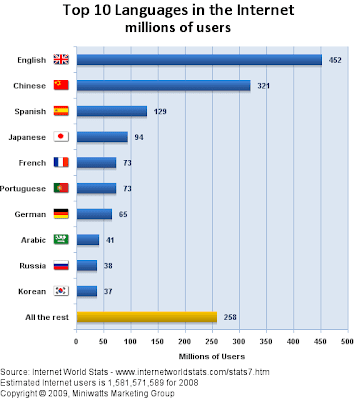
It is obvious that English was the most commonly spoken language by Internet users.
Unsurprisingly, the number of Chinese was also large.
The number of French and Portuguese users was exactly the same at 73 million each.
The number of Arabic, Russian and Korean users was similar, with 41, 38 and 37 million users respectively.
Korean was the least common language spoken by users.
It is interesting to note that six out of the top ten languages were European, while three were Asian.
There is too much information! I really don’t know what to choose!
If there are a lot of things being compared in the graph, or the information is complex, then you will need to group the information. Here are some ideas:
|
Types of things being compared
|
Possible groupings
|
|
sports / leisure activities
|
dangerous / safe
indoor / outdoor
social / solitary
|
|
countries / languages / people
|
Western / Eastern
rich / poor
developed / developing
small / large
|
|
energy
|
fossil fuels / renewable fuels
polluting / clean
|
|
transport
|
public / private
|
Look at this example from the Economist magazine.
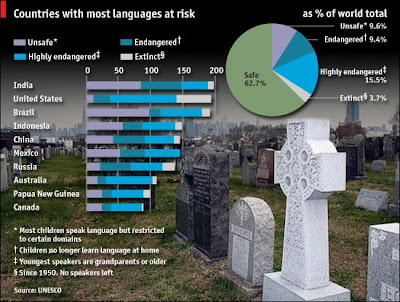
Divide the countries into developed and developing. You will a see general pattern:
Generally speaking, developed countries have larger proportion of endangered, highly endangered and extinct languages.
Look at the size of the countries:
With the exception of Papua New Guinea, all the countries are fairly large.
Tip Summary:
- Look for the six features
- Group information. (Also good for writing introductions!)
2014年2月23日 星期日
雅思寫作示範: Map – LA Freeways
IELTS Task 1 Writing – Los Angeles’ Freeways
Map
Comparing two past times
Comparing visual information
Before You Read
What kind of overview could you include?
What tenses will you need to use?
The development of freeways in and around Los Angeles from 1995 to 2005
 Sample Answer
Map
Comparing two past times
Comparing visual information
Before You Read
What kind of overview could you include?
What tenses will you need to use?
The development of freeways in and around Los Angeles from 1995 to 2005
Sample Answer
The two figures show the change in highway development in the Los Angeles area between 1955 and 2005. It can clearly be seen that while in general more freeways were constructed throughout the city of Los Angeles, the largest proportion were built to the South East of the city.
In 1955, there were few highways in the area. The longest ran from Hollywood, to the center of the metropolitan area, and on to the South East. Smaller roads also ran out from the city center to Pasadena, and Alhambra. However, most of the city itself was not connected. Another important point is that at this time the freeway to Long Beach was only half completed. Moreover, the entire route to San Pedro was still under construction.
In contrast, by 2005 there had been a dramatic expansion in the freeway network. Not only had all the previously unfinished roads been completed, but hundreds of additional kilometers had been built, connecting all of the smaller townships, now 15, with the exception of Redondo Beach. It was now possible to travel along the freeway from East to West and North to South.
Answers – Before You Read
The number of freeways increased. The extent of the network grew. More towns were connected. Where most of the freeways tended to be.
Past perfect is useful because you are talking about a time before a time in the past. And past simple.
2014年2月21日 星期五
【學員Kevin鄭推薦】重拾英文的信心
 對你來說,英文是什麼?你對英文的第一印象是甚麼?你有想過嗎!他對你未來的影響!來學英文到底是有用還是沒用?你會想說:「它有什麼用處!他並不會給我任何的改變。」但如果你是擁有偉大的理想與抱負、你是個有夢的人,那為何不築夢踏實呢?為什麼不實現你那崇高的鴻鵠之志呢!
在這之前,你要了解你的未來,時間如金錢,但光陰卻似箭,一去不復返,何不把握住現有的時光,擴充你的腦容量,增廣見聞,提升自己的能力,造就出夢想的未來。
現在的社會其實非常現實,國際通用語言就是英文,在國外,語言不通也是用英文,你會想說:「為什麼不是中文?」但現實就是如此,與其怨天尤人,不如為未來出幾分力。
而我為什麼選擇流利,因為它提供一個很好的學習環境,不僅有上課活潑的外國老師,也可以交到許多好朋友,在這裡上課真的沒有壓力,老師上課也不會很嚴肅,就像在聊天一樣,真的很好。
我在流利已經一年了,有時回想起之前的補習班,因為怕犯錯還有跟不上進度,使我對英文沒有了信心,之後上了國中,從好友那了解英文的重要性,建議我來流利看看,一開始並沒有太大的期待,但經過試聽後才發現,英文也可以這麼有趣,使我再度燃起了信心,要把英文學好,當然,也希望大家也能把英文重視,了解它的重要性。
2014年2月20日 星期四
IELTS雅思寫作技巧:小作文/圖表題的開場白
IELTS Task 1 Writing Tip:
Writing an introduction to a graph
How important is an introduction?
開場白很重要嗎?
Very important. You need an introduction to help introduce your piece of writing to the reader.
Can I use the title of the graph?
我可以將圖表題題目上的敍述直接抄寫上嗎?
No. If you copy the exact words as the title, the words will not be counted.
What information should I include in the introduction?
那麼,開場白怎麼寫?
Include:
the subject of the graph
the time
the place
the categories (if there are over three, don’t bother writing them all out)
the units of measurement (in tonnes, in kilograms etc…)

Example
The bar graph shows the number of male and female civil partnerships in Britain from late 2005 to 2007.
Remember, your introduction does not need to be too complex. Use this opportunity to have a completely correct sentence!
What if the graph is in the past? Should the introduction be in the past tense too?
如果圖表為過去資料呢?開場白是不是也要使用過去式?
No. Because you are looking at the graph now, use the present tense in the introduction.
People tell me I need to change the words from the title. How can I do that?
常有人告訴我把Task 1內文裡的字改掉就好…請告訴我該怎麼做?
If the graph describes people from a country, the easiest way is to use a different word form.
Country
國家(名詞) Nationality
國籍(形容詞
England English
Wales Welsh

Example
The line chart compares the English and Welsh General Marriage Rate from 1981 to 2006.
Writing an introduction to a graph
How important is an introduction?
開場白很重要嗎?
Very important. You need an introduction to help introduce your piece of writing to the reader.
Can I use the title of the graph?
我可以將圖表題題目上的敍述直接抄寫上嗎?
No. If you copy the exact words as the title, the words will not be counted.
What information should I include in the introduction?
那麼,開場白怎麼寫?
Include:
the subject of the graph
the time
the place
the categories (if there are over three, don’t bother writing them all out)
the units of measurement (in tonnes, in kilograms etc…)
Example
The bar graph shows the number of male and female civil partnerships in Britain from late 2005 to 2007.
Remember, your introduction does not need to be too complex. Use this opportunity to have a completely correct sentence!
What if the graph is in the past? Should the introduction be in the past tense too?
如果圖表為過去資料呢?開場白是不是也要使用過去式?
No. Because you are looking at the graph now, use the present tense in the introduction.
People tell me I need to change the words from the title. How can I do that?
常有人告訴我把Task 1內文裡的字改掉就好…請告訴我該怎麼做?
If the graph describes people from a country, the easiest way is to use a different word form.
Country
國家(名詞) Nationality
國籍(形容詞
England English
Wales Welsh
Example
The line chart compares the English and Welsh General Marriage Rate from 1981 to 2006.
2014年2月19日 星期三
留學考試實現雅思聽力滿分的四個步驟
眾所周知,雅思考高分容易,考滿分很難。現在為大家介紹留學考試實現雅思聽力滿分的四個步驟
雅思聽力涉及國外留學生活的方方面面,如果聽不懂在國外生活就有些難度,大家也都知道想要取得雅思聽力高分容易,但是滿分就很少了,下面是雅思聽力生存、文化、課上、課下的相關介紹:
Section 1 稱之為Survival(生存聽力), very basic.
要是連這一部分都聽不懂,就沒法在國外生活。這部分聽力涉及的是國外生活的方方面面,如租房、旅行、諮詢、看病等。由於原本就已經包羅萬象。備考時,只要準備全面,熟悉各場景考查的重點方面,以及一些核心詞彙,再在考前輔以機經詞彙,就足以應付了。
Section 2 應該稱之為Culture(文化聽力),a little more depth.
這一部分主要是向考生們介紹英國,澳大利亞等國的風土人情,如傳統節日、特色旅遊、電台節目、社交生活、校園生活等。但隨著內容的擴充,難度也在擴大,S2 在09出了很多的新題,這還不是最可怕的,因為新題雖多,還入窠臼,新題仍然脫不了一個大範圍——英聯邦國家的文化特色。最可怕的是在題型上足足比S1上 了一個重量級,比如Paraphrasing的難度會增加,會出現更多的Distractive information和keyword postposition.所以在熟悉場景主要內容的基礎上,考生們要更加註重依靠一些’手段’,也就是解題必要的Skills.
Section 3 是Off Class(課下聽力),the most predictable.
S3最可愛的地方在場景易於預測,它的大部分場景都限定在了課前的Course Selection和課後的Tutorial &Off Class Discussion,而且新年也不會有大的突破,多年來如此……這樣一來,熟悉場景的同學在短短的30“讀題完畢之後,就能預測出錄音的大致內容。再加 上題型難度上S3比起S2上升的不多,輔以熟練的解題’手段’,考生們完全可以把S3的”爭分“變為”保分“。
Section 4 是Lecture &Presentation(課上聽力)。
S4是雅思聽力闖關的最後關口,題型難度上不但有雅思拿手的Paraphrasing, Indirect &Distractive Information, Keyword postposition,還會有更加讓人匪夷所思的Paraphrasing of Noun Keywords(名詞關鍵詞的同意轉換),如facility , construction, industry, business等詞都可以進行轉換,更加大了聽力理解難度。所謂業精於勤荒於嬉,要想克服S4的必殺技,一定要勤練技巧,掌握“手段”。 S4在場景上也處於不斷擴充的過程中,這是近幾年的常態,各種學術話題逐年遞增,除了環境科學、生物科學、商科以外、天文學、考古學、歷史學等話題範疇下 的新題也是層出不窮。由於S4場景擴充的可能範圍太廣——自然科學+人文科學,預測勢必難以為之,大家的策略應該是立足“手段”,挑戰“學術”。
以上即是實現雅思聽力滿分的四個步驟的詳細介紹,大家可以在準備留學考雅思考試的過程中,根據自己的實際情況,選擇適合自己的方法進行實踐和練習。
雅思聽力高分需要克服的三個問題
想要拿到雅思聽力高分,考生需要在備考中對詞彙和技巧等信息進行詳細的準備。
大家一起來看看吧。
第一、放空。
要 一個考生集中精神30分鐘,並且專注地聽幾大段的英文,對於全球那麼多母語非英語的考生來說簡直就是非常折磨的事情。再加上還需要完成試卷上的40個題 目,這對於許多考生來說,尤其是基礎較薄弱的考生,根本就是不可能完成的任務。很多考生在考完試之後都抱怨,在聽到第3部分甚至是第4部分的時候,思想總 會不由自主的渙散,導致大面積的沒有跟上,也就無法取得滿意的分數了。
第二、混亂。
如果僅僅看一篇內容,也許很多考生 都 不會有很大問題,或者僅僅是聽一個7分鐘的材料,明白大意也不會是一件難事。但是當你需要先看懂試卷上的內容,再聽懂5分鐘的材料,並且根據所聽的內容來 完成試卷為給信息的時候,不少考生就會感到非常混亂。自己無法在看和聽中平衡,部分考生甚至乾脆在聽的時候選擇不看試卷,當然他們考試的失敗是可想而知 的。
第三、忘詞。
由於聽力考試大部分都是填空題,精確的填寫詞彙是非常重要的一環。由於時間的關係和思想緊張的原因, 考 試的時候很有可能會寫錯詞,甚至產生幻聽。而這個就是聽力考試中失分最多的一項。有位考生在考完試後無不遺憾的對我說:“老師,我考試的時候忽然忘記 male和female哪一個是男了。”
以上三點就是關於拿到雅思聽力高分需要克服的三個問題,都是大家在聽力考試中經常會犯的一些失誤。避免了這些失誤,相信每一位留學生們會在自己的雅思聽力備考中取得好成績的。
以上轉載自http://mypaper.pchome.com.tw/sinayoulearn/post/1323069686
2014年2月17日 星期一
雅思口說題目分享
Part 1
1. What's your full name? What should I call you?
Tell me about where you live and your town. Where do you live?
How long have you been living?
2. What are the activities you do when you were a child?
Do you prefer indoor activities or outdoor activities? Why?
Do you think now children do the same as what you did when you were a
child?
3. Do you have plants in your house?
Do you like to have it in your house? Why?
Have you ever planted anything?
Part 2
1. Describe a letter you received that is important to you.
You should include who sent it to you, when you received it, what do you do
about it......
2. 考官問: Do you still keep it?
Part 3
1. How often do you think people write letter now?
2. Do you think letter are different from other kind of messages?
3. Do you think letter is differnt from other messages in business?
4. What are the differences between telephone and letter in business?
2014年2月15日 星期六
雅思口說題目分享
PART2
What do you plan in your future
what your make...
when...
what do you make it success...
why...
What do you plan in your future
what your make...
when...
what do you make it success...
why...
PART3
What do you country,Taiwan,children plan in these futurn
What do you ...young...
What do you ...older...
What do we can learn if we plan don't work
Do you think make the plan than older more better
還有更多雅思相關問題:
請至
http://www.academy.com.tw/ielts/index.php
2014年2月10日 星期一
【學員Mandy 推薦】最佳選擇
我是個忙碌的上班族,在穩定的工作之餘,又想替自己的職涯技能上添上幾分色彩,在渡過豐富的大學生活中,我準備好了基本專業的技能,但卻沒有帶走我應具備的語言能力,於是我開始尋覓,直到我遇見了流利,不可諱言,在我踏進門口僅接著面對英文檢測血淋淋的分級能力測驗的時候,真的很想鑽個洞躲起來或逃跑,但這一切都是為了能讓學員在適當的級別學習必然的前置作業,所以還是必須去面對。
完成能力分級後上課的情況,雖然只經歷的半年學程,但我對流利是給予肯定
強大的師資,活潑的教學方式,引導學員開口說話,帥氣的老師(這一點絕對是行銷重要的一環無誤)
在課堂與上班時間不衝突的情況下,我想不到任何理由不繼續在流利修行,
所以客倌們,如果您還在猶豫不前,不妨先來試聽,也許會有意想不到的收獲唷!
投資自己,大步邁進人生勝利組!
2014年1月19日 星期日
雅思作文:圖表題示範解答
Task 1 Writing Sample Answer – Smoking in
Britain (2)
分析
Line Chart 線型圖
Comparing men and women 比較男女
Talking about a “gap” 注意差距的分析
Identifying key points 把重要的時間點定義出來
Sample Answer 作答舉例
The line chart compares the smoking rate
for British men and women from 1948 to 2007.
Most interestingly, although smoking was
much more popular among men than women at the start of the period (65% and 40%
respectively), by 2007 they were nearly identical (approximately 27% and 25%
respectively). In other words, the gap between both groups narrowed
considerably.
There are two other points of interest.
First, despite a small rise in popularity in the 50s, men tended to smoke less
over the time. In contrast, after falling to about 35% in 1955, more women
suddenly began to smoke. Their smoking rate continued to increase until peaking
at around 43% in 1972.
The second point is the dramatic decline in
the popularity of smoking from 1972. After this point, the percentage of male
and female smokers plunged, with both dropping to around 30% by 1990.
In conclusion, despite the temporary rise
in the popularity of smoking among women, it can clearly be seen that the
percentage of smokers of both sexes dropped significantly over the period. In
addition, the gap between both groups narrowed considerably.
186 Words
2014年1月17日 星期五
雅思聽力高分秘訣
眾所周知,雅思考高分容易,考滿分很難。現在為大家介紹留學考試實現雅思聽力滿分的四個步驟
雅思聽力涉及國外留學生活的方方面面,如果聽不懂在國外生活就有些難度,大家也都知道想要取得雅思聽力高分容易,但是滿分就很少了,下面是雅思聽力生存、文化、課上、課下的相關介紹:
Section 1 稱之為Survival(生存聽力), very basic.
要是連這一部分都聽不懂,就沒法在國外生活。這部分聽力涉及的是國外生活的方方面面,如租房、旅行、諮詢、看病等。由於原本就已經包羅萬象。備考時,只要準備全面,熟悉各場景考查的重點方面,以及一些核心詞彙,再在考前輔以機經詞彙,就足以應付了。
Section 2 應該稱之為Culture(文化聽力),a little more depth.
這一部分主要是向考生們介紹英國,澳大利亞等國的風土人情,如傳統節日、特色旅遊、電台節目、社交生活、校園生活等。但隨著內容的擴充,難度也在擴大,S2 在09出了很多的新題,這還不是最可怕的,因為新題雖多,還入窠臼,新題仍然脫不了一個大範圍——英聯邦國家的文化特色。最可怕的是在題型上足足比S1上 了一個重量級,比如Paraphrasing的難度會增加,會出現更多的Distractive information和keyword
postposition.所以在熟悉場景主要內容的基礎上,考生們要更加註重依靠一些’手段’,也就是解題必要的Skills.
Section 3 是Off Class(課下聽力),the most predictable.
S3最可愛的地方在場景易於預測,它的大部分場景都限定在了課前的Course Selection和課後的Tutorial &Off
Class Discussion,而且新年也不會有大的突破,多年來如此……這樣一來,熟悉場景的同學在短短的30“讀題完畢之後,就能預測出錄音的大致內容。再加
上題型難度上S3比起S2上升的不多,輔以熟練的解題’手段’,考生們完全可以把S3的”爭分“變為”保分“。
Section 4 是Lecture
&Presentation(課上聽力)。
S4是雅思聽力闖關的最後關口,題型難度上不但有雅思拿手的Paraphrasing, Indirect
&Distractive Information, Keyword
postposition,還會有更加讓人匪夷所思的Paraphrasing of Noun
Keywords(名詞關鍵詞的同意轉換),如facility , construction, industry, business等詞都可以進行轉換,更加大了聽力理解難度。所謂業精於勤荒於嬉,要想克服S4的必殺技,一定要勤練技巧,掌握“手段”。 S4在場景上也處於不斷擴充的過程中,這是近幾年的常態,各種學術話題逐年遞增,除了環境科學、生物科學、商科以外、天文學、考古學、歷史學等話題範疇下
的新題也是層出不窮。由於S4場景擴充的可能範圍太廣——自然科學+人文科學,預測勢必難以為之,大家的策略應該是立足“手段”,挑戰“學術”。
以上即是實現雅思聽力滿分的四個步驟的詳細介紹,大家可以在準備留學考雅思考試的過程中,根據自己的實際情況,選擇適合自己的方法進行實踐和練習。
雅思聽力高分需要克服的三個問題
想要拿到雅思聽力高分,考生需要在備考中對詞彙和技巧等信息進行詳細的準備。
大家一起來看看吧。
第一、放空。
要 一個考生集中精神30分鐘,並且專注地聽幾大段的英文,對於全球那麼多母語非英語的考生來說簡直就是非常折磨的事情。再加上還需要完成試卷上的40個題 目,這對於許多考生來說,尤其是基礎較薄弱的考生,根本就是不可能完成的任務。很多考生在考完試之後都抱怨,在聽到第3部分甚至是第4部分的時候,思想總 會不由自主的渙散,導致大面積的沒有跟上,也就無法取得滿意的分數了。
第二、混亂。
如果僅僅看一篇內容,也許很多考生
都
不會有很大問題,或者僅僅是聽一個7分鐘的材料,明白大意也不會是一件難事。但是當你需要先看懂試卷上的內容,再聽懂5分鐘的材料,並且根據所聽的內容來
完成試卷為給信息的時候,不少考生就會感到非常混亂。自己無法在看和聽中平衡,部分考生甚至乾脆在聽的時候選擇不看試卷,當然他們考試的失敗是可想而知
的。
第三、忘詞。
由於聽力考試大部分都是填空題,精確的填寫詞彙是非常重要的一環。由於時間的關係和思想緊張的原因,
考
試的時候很有可能會寫錯詞,甚至產生幻聽。而這個就是聽力考試中失分最多的一項。有位考生在考完試後無不遺憾的對我說:“老師,我考試的時候忽然忘記 male和female哪一個是男了。”
以上三點就是關於拿到雅思聽力高分需要克服的三個問題,都是大家在聽力考試中經常會犯的一些失誤。避免了這些失誤,相信每一位留學生們會在自己的雅思聽力備考中取得好成績的。
以上轉載自http://mypaper.pchome.com.tw/sinayoulearn/post/1323069686
2014年1月16日 星期四
雅思口說第二部份
IELTS Speaking Tips Part 2 –
Individual Long Turn 雅思口說測驗奪分技巧 第二部份
Just to remind you there are three parts to the speaking test:
雅思考試通常包含三部份
Part 1 Short questions on common topics that most test-takers should be able to answer
Part 2 Individual Long Turn
Part 3 Discussion
This post doesn’t deal with part 1. If you have trouble with part 1, then you really should not be doing IELTS yet!
Format The examiner gives you a question on a card. It’ll look something like this: 口試官會給您一張卡片,上面會有題目,看起來就像下面:
Describe something that was given to you that you think is important
Say:
What it is and what it looks like
Who gave to you
Where you keep it
And explain why it is important to you.
You have one minute to think about the question you are given and to make notes if you want.
Dos 一定要做:
Do let the examiner finish reading the question to you (they have to, it is in their script)
Do take the time to think about your ideas. Use the minute to think of useful words and phrases.
Do use the prompts (mini-questions) on the cards to organize your talk. It helps you when you get stuck!
Do ask the examiner if you are not sure about a word. You won’t get a lower mark!
Don’ts 千萬不要做:
Don’t start with a pre-prepared or memorized speech.
Don’t talk about a different topic.
Don’t write sentences when you take notes. You don’t have time!
Don’t be worried about talking constantly the whole time. It isn’t natural. Pause sometimes and then move on to the next part of your talk.
Other common questions 其他常見問題解答:
Q. Do I need to answer all the mini-questions on the card?
No. They are there to help you. You must answer the main question.
Q. Do I need to talk for the entire two minutes?
No. You should probably talk between 1.5 to 2 minutes. Examiners have to keep to a time schedule. So, when the examiner is trying to make you stop talking, just stop!
Q. Why does the examiner (sometimes) ask follow-up questions after my Individual long talk?
This is part of the script. If you don’t talk for long, the examiner will ask up to two extra questions. Please keep your answers fairly short! Don’t try to talk for 30 seconds or a minute!
Tips for getting better 讓您考得更好的私房妙招
Every person is different but there are some things everyone needs to do.
1. Improve your general English fluency It is a good idea to practice talking with NO preparation. Cut up short topics or questions. Randomly pick one and try to talk for at least a minute.
2. Practice using the prompts. It is helpful to ask yourself the mini-questions and then answer them. This uses up time, sounds natural, and helps keep your answer well-organized. So, who gave it to me? Well, . . . And why do I think it is important? I suppose it’s because . . .
3. Use filler phrases when you are stuck Practice some chunks or English phrases to explain that you can’t remember or you’ve forgotten a word. What was I saying? Oh! That’s right . . . um . . . [continue speaking] Oh, what’s that word? It’s on the tip of my tongue . . . Where was I? / What was I talking about? Well, anyway . . .
4. You can also practice talking about types of Part 2 questions. The following types are common: People A famous person who you would like to meet. A person who influenced you when you were young. Events and situations A time you were late. A cultural event you have been to. Objects Something you would really like to buy. Something you own that is very useful. Interests A hobby you would like to take up. An interest you have enjoyed doing. Stories/messages An interesting letter or email you received. A news story or article you recently read. REMEMBER the aim is to sound natural!
2014年1月15日 星期三
學習英文:Travel & Tourism旅行與觀光篇
transfer [trænsˋfɝ]
vi 轉換;搬遷
(1)例句:
My flight from New York to China is so long
that I must transfer at Bangkok.
我從紐約到中國的航線由於距離太常,所以必須在曼谷轉機。
同義字詞: change planes
(2)例句:
The luggage was quickly transferred from
the plane onto the luggage carousel to be picked up.
飛機上的行李很快地就被運送到了行李的轉盤輸送帶上等待提領。
souvenir [ˋsuvə͵nɪr]
C 紀念品
例句:
Once you’ve bought all the souvenirs you
can handle, take your receipts to the tax-refund counter.
一旦你已經買好所有紀念品,帶著你的收據到退稅櫃檯辦理即可。
同義字詞: keepsake
schedule [ˋskɛdʒʊl]
(1)vt 安排
例句:The travel agent spent several hours with us scheduling every aspect of our trip around the world.
旅行社和我們花了幾小時安排我們環球之旅的每個部分。
同義字詞: plan, organize
(2)C 行程
例句:
My friend wants to travel around Europe in
6 weeks so he will be on a very tight schedule.
我朋友想在六星期之內遊遍歐洲。所以他的行程將會非常緊湊。
同義字詞: plan, agenda
package [ˋpækɪdʒ]
(1)C 包裹
例句:
It is best to insure a package when sending
it from abroad in case it doesn’t arrive.
從國外寄來的包裹最好用掛號,以免寄丟。
同義字詞: parcel
(2)ph 套裝行程
例句:
A package holiday can be a good bargain and
value for money, although you have less freedom.
度假套裝行程既划算又值得,雖然較少個人自由。
overcrowding [͵ovɚˋkraʊdɪŋ]
U 壅塞
例句:
In the peak tourist season, the main roads
suffer from overcrowding.
一到旅遊旺季,主要道路就會出現壅塞。
同義字: congestion
fare [fɛr]
(1)C 票價
例句:
Train fares are significantly higher than
last year and are now about $20 per person.
火車票價比去年明顯貴出許多,現在大約一個人要二十塊。
同義字: ticket price
(2)U 伙食
例句:
The fare was simple but very filling, with
everyone eating as much as they could.
這裡的伙食便宜又大碗,每個人可以盡情地吃。
同義字: food
deport [dɪˋport]
vt 驅逐出境
例句:
I read the newspaper yesterday saying that
the government had to deport a foreigner as he had broken the law..
我昨天讀到報紙上說政府必須將一名犯了法的外籍人士驅逐出境。
同義字: expel, send home
相關字: deportee (n)
criteria [kraɪˋtɪrɪə]
U 標準
例句:
There are a number of criteria that must be
met to qualify as a five-star hotel.
要符合一些標準才夠資格稱做五星級飯店。
同義字: criterion (singular, n)
ancient [ˋenʃənt]
adj 古代的
例句:
Many countries have ancient ruins that hold
a lot of history.
許多國家都有一些極富歷史性的古代遺跡。
同義字: very old
反義字: modern, contemporary
詞性:
n=名詞 adj=形容詞 adv=副詞 vt=及物動詞 vi=不及物動詞 ph=片語 C=可數名詞
U=不可數名詞 Synonym=同義字詞 Antonym=反義字詞 Related word=相關字詞
由「雅思應考勝經核心單字」作者Benjamin Adams (大Ben老師)熱情提供
訂閱:
文章 (Atom)