顯示具有 雅思 標籤的文章。 顯示所有文章

2014年7月14日 星期一

Amy推薦 IELTS 7!


恭喜 Amy 達成雅思 7.0的目標

Amy順利取得雅思7分的高分,也祝她

IELTS Test Results

- Overall: 7.0 - Listening 7.5 - Reading 6.5 - Writing 6.0 - Speaking 7.0

Amy如何達成目標的呢?

Amy 參加了: - 聽說讀寫高級密集班 (May-2014) - 雅思技巧班 (May-2014) 除此之外,她還參加了一對一課程,更進一步針對自己的弱點加強,並且也定期參加我們的仿真模擬考試。

Amy給流利英語的話:

Hi,  我是Amy
我已經在6/19的考試順利拿到Overall 7.0的成績 同時一併附上我的推薦心得 
在流利英語上課之前也有補過其他補習班的雅思課程,可是成績仍無法有效提昇。很開心在流利只上不到三週的時間,就能讓我能順利考取到理想的成績。我在流利英語除了參加每天扎實的密集班課程另外還有每週兩次的一對一課程。在這邊上課,課程教材不僅豐富也具系統化、老師群們也都非常耐心且親切回答同學的問題。感謝Henry老師,因為每次上課的內容都讓我長了不少知識,而且也提供很多不同可能的想法,讓我在面對雅思口試考試時能靈活的運用並舉出不同的例子,增加答題的豐富性。感謝Alice老師,在每次生動的上課中都能學習到很多扎實的文法。感謝Andrew老師,每次的作文課都是一直不斷在激發自己,尤其作文想法練習能很有效的幫助作文架構的發展。最後感謝一起和我練習口說的夥伴以及流利英語的大家,因為有大家的鼓勵及幫忙,才能讓我順利今年出發到英國圓夢。

2014年5月24日 星期六

Aurora推薦 IELTS 6.5!


恭喜 Aurora 達成雅思 6.5的目標
She has been accepted by the University of Newcastle and will start in September, 2014!
她已經取得 the University of Newcastle 的入學許可即將在2014年九月入學

IELTS Test Results


- Overall: 6.5
- Listening 6
- Reading 6.5
- Writing 6.5
- Speaking 7

Aurora如何達成目標的呢?


Aurora 參加了:
- 聽說讀寫高級班 (Jan-2014)
- 聽說讀寫密集班中級高階 (Nov-2013)
- 雅思預備班 (Nov-2013)
除此之外,她還每天都會到我們的自習教室自習,並且也定期參加我們的仿真模擬考試。

Aurora給流利英語的話:
謝謝流利英語在這段時間的服務以及幫助,讓我順利達成我的目標。

2014年4月28日 星期一

【學員Ricky 推薦】流利英語帶給我最大的成就感

大家好我叫Ricky
很開心可以寫這篇感想,當Mira請我寫的時候我馬上答應了,因為我覺得流利英語學苑相當值得推薦給大家。
其實我不是什麼大咖,我只是一般人,一般到這世界少了我,地球也不會爆炸還是一樣轉動者,世界依然和平。所以應該很能體會課程帶來給我的差別。
我原本是個英文相當爛的人,自從到流利英語學苑上課後感想真的很多。
還記得來上課的第一天,對於我這種許多年沒上課的人來說,感到害怕及壓力,但上課時老師親切的態度,讓我感到放心,也因為我比較內向所以流利英語學苑的小般制的教學讓我感受不到壓力,而且能很快的步入軌道。
老師們上課的內容相當豐富,不單單只是課本上的教材,老師們上課準備了許多豐富的互動,讓我很快的能學習到老師所教的及 所講的,也因為是全美的環境讓人可以快速的步入軌道,真的不誇張,還有老師們也真的都相當超好相處。
我感受到最明顯的一件事,我現在來分享,當我上課一段時間後,發現自己可以用自己不是很強的英文和老師對話,這感覺就好像是,當你小時候不會說話時忽然某天大人們聽懂了這感覺,相當奇妙吧。
我的老師們有Herry和Jhon雖然2位老師的上課方式不太相同,但都能讓我們很快的步入軌道,他們真的很厲害〜最特別的是jhon的英語和Herry讓我們可以很快的了解2者不同。
最後我不是天才,但我在短短的時間內可以進步這麼多,讓我感到非常的震驚和成就感,所以來流利英語學苑相信大家也可以。


2014年4月21日 星期一

【學員Rita 推薦】在流利英語學習是件有趣的事情

很開心有機會能夠到流利英語進修英文,目前加入的是聽說讀寫平日晚上的課程,由於四種方面都要做到訓練,選用的教材方面便非常重要,我非常喜歡我們的課本(Global Intermediate Coursebook)內容充實有趣,並能夠循序漸進有次序地訓練到英語聽說讀寫的能力;

再來除了課本的教學老師也會額外準備一些小活動讓學生互相做練習,在練習的過程中讓學生接觸互動,以英文來認識交新朋友;幾堂課下來發現自己的口語有一點進步,講出來的英語也比較有情緒有韻律,不再是硬梆梆地把每個字都讀出來了!

2014年4月11日 星期五

雅思4/5口說寫作題目分享

雅思4/5的考古題分享給大家
更多雅思相關問題請至
http://www.academy.com.tw/ielts/index.php

Part 1

Where are you from?
What is the name of your hometown?
Is it a bog city or a small place?
How long have you been living here?
What do you like the most about your hometown?
--
Did you often play games when you were a child?
Did you enjoy outdoor or indoor activities as a child?
What are the differences between the games that children play before and
nowadays?
--
How do people in your culture show politeness?
Who taught you politeness when you were a child?
Comparing to the past,does the way people show politeness change in your
country?

Part 2,
Describe an important person of your country.
-Who he/she is?
-What does he/she do?
-Why is he/she important to your country?
-Your feeling about this person
--
Part 3,(I can't recall the complete sentences, but they are all "famous-related"
questions.)
What are the ways to become famous?
Do you think hard work is needed for the people who want to become famous?
What are the differences between the famous people in the past time and now?
Do you think the famous people should behave themselves?
--

Writing task 1,
a table about the weekly spent of international students in 4 countries in
2005 and a bar graph diving the total costs into 3 different types
--
Writing task 2,
The number of cars is increasing. The government will spent more money on the
road system. Some people think the government should pay for this, while
others think the drivers should cover this.
Discuss both sides and give your opinion.

2014年3月27日 星期四

【學員Kelvin 推薦】建議想學好英語的人來試試看!

由於工作的關係我天天都要和外國人一起,因此深刻地感受甚麼是為了考證照學英文和為了融入國外環境學語文之間的差別,流利英語的老師完全是用正常外國人的習慣和學生溝通,像朋友一樣的指導很多外國人的習慣用語,也因為這樣,我看到這裡的學員不管英文好不好都非常勇於開口,一旦肯講進步速度就很快。
加上教材不會很死板,生活化並有系統的從文法或是發音等等一步一步讓你練習,讓你不會很無聊。
對我而言學語言最重要的是環境和教學方式,流利英語是一個很好的環境讓我有勇氣開口,也有很好的教學方式在每一個階段讓我重複的練習文法,一但有了基礎就會有信心,學習語言就會變成一種有趣、主動的事情,我現在也開始把所有的生活環境改成英文,電腦介面換成英文、看英文書、英文字幕電影、玩英文遊戲甚至開始認識一些外國人。
有別於許多英語連鎖補習班用高額補習費加上便宜師資創造高額利潤,我挑流利因為他只有一家,老闆就是一個希望台灣人英文變好的外國人,師資也都是國外認證過的老師,出發點完全為了學員,所以我建議想學好英語的人來試試看!

2014年3月18日 星期二

雅思口說考古題

part1
   住哪個城市?喜不喜歡?未來會不會搬
   喜歡哪種音樂??為什麼?什麼時候聽??
   不喜歡哪種音樂??
   為什麼有人喜歡買衣服
   你工作時穿什麼衣服??
   回家會不會換衣服??
  part2
   講一次離家出遠們的經驗??
   什麼時候??為什麼要出遠門??
   搭什麼交通工具??
   對於這次出遠門的經驗有什麼感覺??
  part3
   過去的人和現在的人旅遊有什麼不同???
   年輕人和老人旅遊經驗有什麼不同??
   有了網路和電視是不是就不需要實地旅遊了??

更多資訊:
http://www.academy.com.tw/ielts/index.php

2014年3月17日 星期一

Writing a Statement of Purpose (SOP) 如何撰寫讀書計劃

Many Chinese-using students ask me to edit a Statement of Purpose, or SOP (S.O.P). They usually have the same problems too. Of course there are the common examples of poor grammar and Chinese English, but the most serious issues are irrelevant content andconfusing organization.
許多學生要我幫忙修改他們的讀書計劃 - 我發現他們通常犯了同樣的錯:除了常見的問題如文法錯誤和中式英文外,大部份的問題都是「內容不相干」及「令人困惑的組織結構」。

What do foreign Universities want to find out? 國外大學想知道的是什麼?

Before you start writing your SOP, ask yourself: 在您開始動筆寫讀書計劃前,問問自己下列問題:

What information does the department/university want from me?
What are they trying to find out?
What kind of student are they looking for?

Usually, university recruiters want to know that: 通常,大學的審查員想知道下列的事情:

  • You can complete the course
  • You are motivated and interested in their course/program
  • You are organized and have a clear sense of purpose
  • You are mature and can handle living overseas
If you are applying for a research degree, you also will need to provide a clear outline or study plan. Also, if you are applying for an MBA, you will need to demonstrate some additional qualities, this will be discussed in another post.

Avoid irrelevant and vague information 避免不相干、模擬兩可的資訊


DON'T use hundreds of words describing your background or your time or achievements in school. Only include information which directly supports your application. If you are unsure, ask yourself, Would the university be interested in this? Does this fact make them want to talk to me? Often, this kind of background information is not needed.

DON'T say vague stuff about how the university has a great reputation and other general statements like it has wonderful resources. This kind of thing can be said about any reasonable university. It is better to find something unique or interesting about the university that appeals to you. This also shows that you have tried to find out about the university. E.g. I'm really looking forward to studying at the X center for X studies. OR I particularly want to take X's course in Y subject.

Have a clear, easy to follow essay structure 使用清楚易懂的文章結構

Paragraph 1: Introduction 第一段:引言
Say why you want to go to X university and study Y course / program. Make this obvious. Don't put this point at the end of the paragraph. Try to identify unique aspects of the university or program. If you can't, it may mean you don't really want to go to this place.

Paragraph 2: Motivation 第二段:動機
Explain why the topic / program is particularly interesting. What / who has inspired you to get involved in this field? How long have you been interested in it? Was there a critical moment or time when you realized that this was what you wanted?

Paragraph 3: Key Achievements / Personal Highlights 第三段:個人傑出表現、成就
Try to select several features of your life/academic career/working career which demonstrate you have the abilities/knowledge/personal qualities or other points that are needed for the program. These will differ according to what you plan to do: BA/MBA/Masters/PhD and so on.

Paragraph 4: Future Goals 第四段:未來目標
Medium term - upon your return to your country
Long term - 5-10 years
Here, try to show how you will use what you have gained in order to benefit others.

Paragraph 5: Conclusion 第五段:結尾
A simple conclusion repeating your qualities, experience, determination, motivation etc so you will be an excellent candidate for the program. You could also add how you will make the department different, or how you will improve the university's image.

Example: In conclusion, I believe I have the qualities and motivation required to succeed in X program. not only am I a strong candidate, but I will bring ...  to the department.


Have well-organized paragraphs 每段都需有良好組織

Make sure your points all support your topic sentence.
DON'T provide ideas and then make your point.
DO introduce your point first and then support it with ideas.

Tell the Truth! 說實話!

DON'T lie. You can exaggerate slightly but avoid lying. It isn't necessary to say what you are not to get into most courses. Remember, you are trying to show you are mature.
DON'T pretend you are a saint or perfect. No one is. Mistakes could be mentioned especially if they are followed by learning or improvement.

How much should I write? 要寫多少字?

It depends on the program you are applying for. But, generally try to keep your SOP to 1-2 pages.

- written by ben / translated by amber

雅思口說考古題

part 1
1. Are you a student or do you work?
2. Do you enjoy your work? why?
3. 有換工作的打算嗎?
4. Do you like sunshine? why?
part2
請說明一個你常瀏覽的網站
part3
1. 延續上一個話題 現在年輕人喜歡逛哪些網站
2. 對於網路購物跟實體店面購物的想法
3. 報紙是不是可以完全被網路新聞所取代

更多內容
http://www.academy.com.tw/ielts/index.php

2014年3月14日 星期五

【學員Luke推薦】流利英語學習最有趣

轉眼間我來流利英語學苑也快半年了,還記得我來考入班考試的當天,當我看到老外準備要跟我對話時,我整個人完全呆住了,從以前到現在,我頂多在學校背背英文單字,很少會開口講英文。所以當時我只好硬著頭皮上啦。考完後我發現文法、單字錯的一蹋糊塗,那天我便開始投入IE2 英文密集班初級的課程,第一堂課真可說是一個震撼教育呀,我發現怎麼每個人都說得這麼棒呀!我便下定決心雖然我比別人晚開始,但我要比別人更認真、更努力一定可以超越其他人。還記得當時我的老師是Warwick 他是一個非常親切的老師,不管是一個字還是一句話,他總是不厭其煩地糾正我們的發音、語氣,還記得有一次下課時老師還特別留下來單獨指導我口說,像我這種毛病特別多的學生,一般老師一定都直接略過,但他竟然足足教了我半個小時,也讓我十分感動,也是他讓我有信心開口說英文。到現在我升上了IE3英文密集班中級,和一些外籍老師聊聊天對我來說已經不是一件那麼困難的事了,不久之前我在家附近的早餐店看到一群完全不會講中文的僑生,和一個年紀一大把的老闆娘點餐,我在一旁看著他們比來比去,指來指去,都沒有一個結論,我就上前去充當翻譯員,幫助他們吃到美味的早餐。不只如此,除了口說外此學苑還提共了一整櫃的英文小說,讓每個學生藉此增加自己的單字量,對我來說,學英文的目的不只是為了要應付學校的考試,英文在現今社會已經成為一個非常重要的語言,不管在職場上,還是旅遊上,語言通了,很多事情就可以簡單解決,不妨大家都抽個空來流利英文學院聽聽看,會收到意想不到的效果唷。

學員背景:五專生,去年來學苑參加暑期密集班,中間因為時間無法配合,有試著加入別的補習班課程,最後因為還是最喜歡流利老師的教法,所以今年學校放寒假時跑回來上課,學校開課後改上晚上的課程。
上課期間:2013年7月~8月、2014年1月~迄今。
上課班級:暑期白天密集初中級班、白天密集中級班、聽說讀寫中級班


Should I do TOEFL iBT or IELTS? 考托福?還是考雅思?

If you are thinking about studying overseas in an English speaking country or an European University, then you will probably need to take an English proficiency test. But which one should you choose?

The two most common English tests for university admission are the IELTS and TOEFL tests. This article will compare both to choose the best one for you.

Basic Information about the exams 雅思和托福的基本資訊

The IELTS exam, or International English Language Testing System, is developed by UCLES, University of Cambridge Local Examinations Syndicate (UCLES and delivered by the British Council and IDP Education Australia. The test is available in an Academic and General Training Module (only the writing and reading are different). Here, we are talking about the Academic module.

The TOEFL Test, or Test of English as a Foreign Language, is developed and delivered by ETS, the Educational Testing Service, a non-profit American company that has a virtual monopoly. The test is available in a paper-based version (PBT), a computer-based version (CBT) and an Internet-Based Version (IBT). Here, we only look at the Internet-Based Test.
All are non-profit organizations – but do occasionally make money.

Cost 考試費用

The cost of the IELTS test can vary depending on whether the provider is IDP or The British Council, but currently it is NT$5,100 in Taiwan (around US$160) while the TOEFL is US$160.

How many times I can take the tests? 我應該考幾次雅思 / 托福?

IELTS test is available on 48 fixed dates a year – for specifically available dates you need to contact your local center while the TOEFL is available in any 7-day period. There is no limit to the number of times you can take the test

Acceptance 學校接受度

It used to be the case that IELTS tests were only accepted by British, Australian, New Zealand and Canadian schools while TOEFL dominated in the US. How things have changed! Now, the two tests are literally competing with each other and nearly any school you wish to go to will accept both.

Difficulty 考試難易度

Students often ask which is more difficult. Unfortunately, the answer really depends on your individual situation and your learning experience. It can also depend on your learning style and how you think. In many cases, difficulty depends on the type of tasks in each test.

How are IELTS and TOEFL different? 雅思和托福的差異性?

In the IELTS exam, the speaking test is divided into three parts: (1) general topics, (2) the individual Long turn, and (3) discussion. Part one involves answering common English type questions on up to three or four topics such as flowers, the Internet, and your hometown. In part two, you are given a topic to talk about for two minutes and one minute to prepare for it. In part three, the examiner will discuss with you a variety of issues and ideas with you related to the topic. So, if you had to talk about a famous person you admired in part two, you may end up discussing the idea of fame, and whether or not famous people should consider how they influence society.
In the TOEFL iBT things are quite different. To begin with, you are facing a computer, not an examiner. You begin with 2 questions where you have to report and comment on what you hear. You then have integrated questions that require you to read some information and then listen to something. For example, you may read about library opening times, and then listen to someone talking about what they have to do that day. There is also a task that requires you to listen to someone talking about a problem and the test-taker has to summarize the situation, the problem and what they think the speaker ought to do.
Overall, many English learners prefer the Face-to-Face Interview in IELTS. You are able to ask the interviewer to clarify, explain words or repeat the question, which makes it easier to make sure that you answer the question properly. In the IELTS test, asking questions does NOT reduce your score. On the other hand the TOEFL test environment can be noisy and uncomfortable since you listen to pre-recorded questions and speak into a microphone in a room filled with other people. You also have a fixed time limit while the IELTS is more flexible.
The other thing to consider is the type of questions themselves. The biggest problem with the TOEFL speaking for some people is that it may be difficult to catch the ideas in the integrated speaking questions. That said, the TOEFL speaking questions are not as complex. IELTS questions can become quite sophisticated in part 3.

Listening 聽力考試

IELTS and the TOEFL iBT differ in question types, format, content, length and accent. First, in the iBT all questions are multi-choice format, checking or matching. IELTS, on the other hand, has a wider range of question types and it often asks you to write exactly the words you hear. Spelling is critical.
In the iBT test, apart from the first part, all are lectures or mini-lectures. While IELTS has a conversation in Part 1, a monologue on a topic of general interest in Part 2, a 2-4 person discussion in an academic context in Part 3 and a simplified lecture in Part 4.
As for accents, IELTS prides itself on the fact that it has a real range including British, Australian, and North American, while in the iBT students will hear British, American, and Canadian. Length also differs with the IELTS being considerably shorter at 30-40 minutes + 10 minutes transfer time while the iBT will be between 60-90 minutes since ETS (the test developer) may try out a new test on the tester.
Regarding content, TOEFL listenings tend to be more academically specialized. They are more likely to ask questions about cells, and molecular biology. Although IELTS listenings are also academic, they tend to be more general. The main reason why people find IELTS listenings difficult is that they require you to write down words and phrases, which is difficult because usually the keywords are synonyms or paraphrased AND you have to spell correctly! Finally, if you are used to American English, you will find the IELTS test to be a little more challenging just because of the wider range of accents.

Reading 閱讀考試

Interestingly, the IELTS and iBT reading sections are fairly similar. You will face 3 readings in the IELTS and 3-5 in the iBT – again because of ETS’ testing policy. this also means the iBT is longer at 60-90 minutes compared to the IELTS’ 60. There are a greater range of question types in IELTS including multi-choice, writing words, matching, summarizing, Yes / No / Not Given and others. The iBT tends to have more multi-choice questions. It also has checking and matching questions along with some questions that test a students awareness of a passage’s organization.
Again, the main difference is in the format of the questions. Again, the IELTS requires a much better control over your language. Some of the tasks require you to understand what types of words (verb, noun, adjective etc) could possibly fit in a space. There are also some challenging tasks – especially the Yes / No / Not Given questions! In other words, if you have a very strong passive vocabulary (you can understand the basic meanings of many words) and are good at eliminating options then TOEFL will be better for you. That said, if you have a wider general awareness of language and reading then you will understand more of the IELTS reading as the TOEFL iBT is more subject specific.
This is the part where the two exams differ the most. The TOEFL iBt requires an integrated writing task and a simple (independent) essay task while IELTS requires students to write one essay and one report based on visual information. Both are challenging and difficult in different ways.
Looking at the standard essay types first, in both cases, students are asked to write a formal essay in response to a prompt.
IELTS prompt types:
- Present and support an opinion (agree/disagree)
- Discuss problems/solutions
- Weigh two arguments
- Compare advantages and disadvantages
TOEFL prompt types
- Present and support an opinion (agree/disagree)
- Explain a preference
- Comparison and contrast
- Description and evaluation
- If / Imaginary
Generally, TOEFL questions are much easier to understand than IELTS questions. TOEFL questions need to be a little longer at 300 words to IELTS 250.
The IELTS (Academic) Task 1 question type is the one that gives many students trouble. Here, they are asked to describe a piece of factual information such as a table, chart, or process in 150 words. Students often find it difficult to work out exactly what they are supposed to be writing.
The iBT Integrated Essay is very different. Students need to listen to a speaker and read a short article that either supports or contradicts the speaker. They then need to write a short report summarizing the key points presented
The TOEFL integrated task is difficult since you need to read and listen and make notes about what you hear before writing. This can be difficult for students. However, it is balanced by the second writing task which is often much easier to understand than IELTS writing topics! In fact, the writing is nearly always the most challenging section for IELTS students, Not only do you have to master a wide range of writing styles for Task 1 where you have to describe data, you also lose marks in IELTS if you do not directly answer the question. This is a common problem!
It is also important to think about some practical matters. You currently need to handwriteyour writing in IELTS while you use a computer in the iBT. Timing is also important. In the IELTS test, you have longer and the time is more flexible. You have 60 minutes and the student is able to divide the time as they wish. In contrast, in the iBT you only have 20 minutes to complete the first task and then 30 minutes to complete the second task.

So which is better? 哪一個考試較適合我?

It really depends, both are very widely accepted and they cost about the same. The real issue is if you feel that you will do better in one format or the other. For example, if you have terrible spelling, you WILL score lower in the IELTS Listening test. On the other hand, if you are a weak speaker and need a bit of help, then the IELTS speaking format will help. So, it is up to you!
What ever your decision, good luck with your test!

2014年3月11日 星期二

【學員Ling推薦】流利英語學習最有趣

學如逆水行舟,不進則退。這句話就驗證在我這個上班族身上,因此去年決定好好的加強自己的語言能力。流利英語學院不同於其他英語補習班的大班制,通常一班不會超過十位學員,因此上課時老師可以兼顧到每位學生,這點很不同於大班制。
流利英語學院的教學方式是:針對每一小單元結束後都會有小測驗,讓我可以知道這幾週當中自己的學習狀況;課堂上的任何問題都可以即時發問,老師也會立即回應。課堂上也不會只有教授課本上的內容,老師有時會準備一些英文小遊戲,透過這些有趣的小遊戲來測驗我們的文法、發音或增廣見聞,例如:澳洲的綿羊比人多、世界上最多英節的單字是哪個國家……等等。很不同於我在校園裡接觸的英文課,讓我學習英文越學越有興趣。
學員背景:忙碌的上班族加上母親,英文目標想學習到B1以上。
上課班級:聽說讀寫初中級班、聽說讀寫中級班
上課期間:2013年7月~迄今。


2014年3月6日 星期四

【學員Samantha推薦】流利英語最棒的選擇

很開心能到流利學習英文,在這裡有親切的職員,會時常關心我的學習的狀況,而且更有優秀的外籍老師幫助我,讓我每次上完課後,英文能力又往上提升了,並且不斷的進步。流利所使用的教材我很喜歡,因為課本除了內容有趣之外,教材還提供了線上的學習的平台,讓我不管是下班後或是休假在家,也一樣可以持續練習並增進我的英文能力。
如果想要好好的學習英文,來流利是明智的選擇!! ^^


2014年3月2日 星期日

雅思口說考古題分享

part1
住哪裡?
你會怎麼形容你住的地方?
喜歡參加party嗎?
喜歡參加朋友的party 或者家人的party?
你覺得老人或年輕人誰比較喜歡開趴?
小學的時候喜歡唱歌嗎?
現在還是常唱歌嗎?
你最喜歡的歌手是誰?
你覺得歌詞重要嗎?

part2
描述一個你特別偏好的網站
為什麼?
容易使用嗎?
part3
你覺得哪些網站很受到歡迎?why?
(我講了跟part2一樣的, 被要求再多舉個例子)
說說看網購的好處與壞處?
哪些網站的內容是可以被信賴的?
網路新聞能否取代傳統報紙?

2014年2月26日 星期三

IELTS Task 1 Bar Chart Sample Answer: Oil Consumption

IELTS Task 1 Sample Answer: Oil Consumption


  • Bar Chart
  • Future Tenses
  • Grouping and comparing predictions


Sample IELTS Task 1 Writing Answer
The bar chart compares the thirst for oil (in billions of barrels per day) in selected OECD and non-OECD countries and regions in 1980, 2008 and in 2030. It can clearly be seen that, while global demand for oil has remained, and is expected to remain, stable in the rich world, it will continue rising, in the developing world.Firstly, despite rising slightly from approximately 41 billion barrels per day in 1980 to around 43 28 years later, the OECD’s total demand is predicted to actually drop below it’s 1980 level. This is likely due to the drop in Japanese and European demand. Even the United States, which accounts for around half of the oil consumed in the rich world, will consume a little less in the future.

Turning to the rest of the world, the figures show that oil consumption will rise dramatically. In fact, it rose around three-quarters from 1980 to 2008 and is forecast to have increased to almost 55 billion by 2030. At this point, its’ oil consumption will be greater than that of the rich world. Of this, Asian consumption will rise the fastest and will be 6 times higher than its’ 1980 level by the end of the period.

In conclusion, while global demand for oil will keep growing, the developing world is going to consume the majority of it in the not too distant future.

Words: 238

Note: Although this answer is much longer than usual, it does contain a lot of information.

From the Economist
A developing thirst
Nov 10th 2009
How demand for oil will change by 2030GLOBAL demand for oil is set to rise from 84.7m barrels per day (bpd) in 2008 to 105m bpd in 2030, says the International Energy Agency in its latest annual energy report. Transport will account for 97% of this increase as rising numbers of cars hit the roads of the developing world. Demand from these countries will overtake that of the industrialised OECD nations by 2030. By then, America, Japan and Europe will be using less oil than in 1980. But the thirst for oil will balloon in Asia—and in India and China in particular—where demand is predicted to rise by as much as 400% compared with 2008.

2014年2月24日 星期一

雅思圖表題寫作技巧

Selecting information from a graph (Graphs that don’t change)


Should I describe all the information?
No. You should only choose the most important information. If you try to include all the numbers it will be boring, and hard to read.


OK – so what information is important?
This is not an easy question to answer. Usually you should look for the following six features:


  • The biggest / smallest thing
  • Something similar / different (comparisons)
  • Something the same
  • Something surprising / unsurprising
  • Something interesting
  • An exception

However, your graph may not have all of these features.


Example sentences


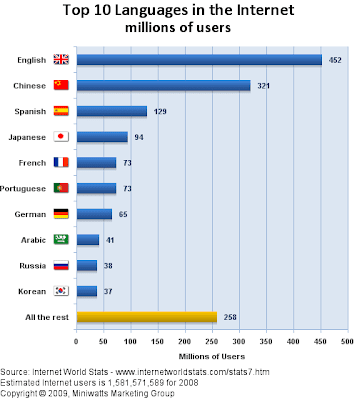
It is obvious that English was the most commonly spoken language by Internet users.


Unsurprisingly, the number of Chinese was also large.


The number of French and Portuguese users was exactly the same at 73 million each.


The number of Arabic, Russian and Korean users was similar, with 41, 38 and 37 million users respectively.


Korean was the least common language spoken by users.


It is interesting to note that six out of the top ten languages were European, while three were Asian.


There is too much information! I really don’t know what to choose!
If there are a lot of things being compared in the graph, or the information is complex, then you will need to group the information. Here are some ideas:
 Types of things being compared
 Possible groupings
 sports / leisure activities
  dangerous / safe
indoor / outdoor
social / solitary
 countries / languages / people
  Western / Eastern
rich / poor
developed / developing
small / large
  energy
 fossil fuels / renewable fuels
polluting / clean
 transport
 public / private

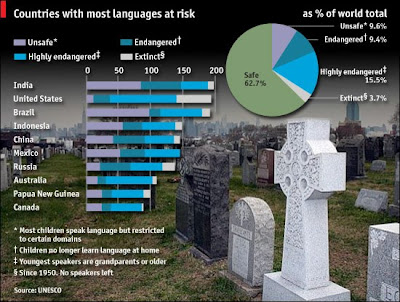
Look at this example from the Economist magazine.


Divide the countries into developed and developing. You will a see general pattern:
Generally speaking, developed countries have larger proportion of endangered, highly endangered and extinct languages.


Look at the size of the countries:
With the exception of Papua New Guinea, all the countries are fairly large.


Tip Summary:

  • Look for the six features
  • Group information. (Also good for writing introductions!)

2014年2月23日 星期日

雅思寫作示範: Map – LA Freeways

IELTS Task 1 Writing – Los Angeles’ Freeways
Map
Comparing two past times
Comparing visual information
Before You Read
What kind of overview could you include?
What tenses will you need to use?
The development of freeways in and around Los Angeles from 1995 to 2005
Sample Answer
The two figures show the change in highway development in the Los Angeles area between 1955 and 2005. It can clearly be seen that while in general more freeways were constructed throughout the city of Los Angeles, the largest proportion were built to the South East of the city.
In 1955, there were few highways in the area. The longest ran from Hollywood, to the center of the metropolitan area, and on to the South East. Smaller roads also ran out from the city center to Pasadena, and Alhambra. However, most of the city itself was not connected. Another important point is that at this time the freeway to Long Beach was only half completed. Moreover, the entire route to San Pedro was still under construction.
In contrast, by 2005 there had been a dramatic expansion in the freeway network. Not only had all the previously unfinished roads been completed, but hundreds of additional kilometers had been built, connecting all of the smaller townships, now 15, with the exception of Redondo Beach. It was now possible to travel along the freeway from East to West and North to South.
Answers – Before You Read
The number of freeways increased. The extent of the network grew. More towns were connected. Where most of the freeways tended to be.
Past perfect is useful because you are talking about a time before a time in the past. And past simple.

2014年2月21日 星期五

【學員Kevin鄭推薦】重拾英文的信心

對你來說,英文是什麼?你對英文的第一印象是甚麼?你有想過嗎!他對你未來的影響!來學英文到底是有用還是沒用?你會想說:「它有什麼用處!他並不會給我任何的改變。」但如果你是擁有偉大的理想與抱負、你是個有夢的人,那為何不築夢踏實呢?為什麼不實現你那崇高的鴻鵠之志呢!
在這之前,你要了解你的未來,時間如金錢,但光陰卻似箭,一去不復返,何不把握住現有的時光,擴充你的腦容量,增廣見聞,提升自己的能力,造就出夢想的未來。
現在的社會其實非常現實,國際通用語言就是英文,在國外,語言不通也是用英文,你會想說:「為什麼不是中文?」但現實就是如此,與其怨天尤人,不如為未來出幾分力。
而我為什麼選擇流利,因為它提供一個很好的學習環境,不僅有上課活潑的外國老師,也可以交到許多好朋友,在這裡上課真的沒有壓力,老師上課也不會很嚴肅,就像在聊天一樣,真的很好。
我在流利已經一年了,有時回想起之前的補習班,因為怕犯錯還有跟不上進度,使我對英文沒有了信心,之後上了國中,從好友那了解英文的重要性,建議我來流利看看,一開始並沒有太大的期待,但經過試聽後才發現,英文也可以這麼有趣,使我再度燃起了信心,要把英文學好,當然,也希望大家也能把英文重視,了解它的重要性。


2014年2月20日 星期四

IELTS雅思寫作技巧:小作文/圖表題的開場白

IELTS Task 1 Writing Tip:
Writing an introduction to a graph


How important is an introduction?

開場白很重要嗎?
Very important. You need an introduction to help introduce your piece of writing to the reader.


Can I use the title of the graph?
我可以將圖表題題目上的敍述直接抄寫上嗎?
No. If you copy the exact words as the title, the words will not be counted.


What information should I include in the introduction?
那麼,開場白怎麼寫?
Include:
the subject of the graph
the time
the place
the categories (if there are over three, don’t bother writing them all out)
the units of measurement (in tonnes, in kilograms etc…)


Example
The bar graph shows the number of male and female civil partnerships in Britain from late 2005 to 2007.


Remember, your introduction does not need to be too complex. Use this opportunity to have a completely correct sentence!

What if the graph is in the past? Should the introduction be in the past tense too?
如果圖表為過去資料呢?開場白是不是也要使用過去式?
No. Because you are looking at the graph now, use the present tense in the introduction.


People tell me I need to change the words from the title. How can I do that?
常有人告訴我把Task 1內文裡的字改掉就好…請告訴我該怎麼做?
If the graph describes people from a country, the easiest way is to use a different word form.


Country
國家(名詞) Nationality
國籍(形容詞
England English
Wales Welsh


Example
The line chart compares the English and Welsh General Marriage Rate from 1981 to 2006.


2014年2月17日 星期一

雅思口說題目分享

Part 1
1. What's your full name? What should I call you?

   Tell me about where you live and your town. Where do you live?

   How long have you been living?

2. What are the activities you do when you were a child?

   Do you prefer indoor activities or outdoor activities? Why?

   Do you think now children do the same as what you did when you were a
   child?

3. Do you have plants in your house?

   Do you like to have it in your house? Why?

   Have you ever planted anything?

Part 2

1. Describe a letter you received that is important to you.

   You should include who sent it to you, when you received it, what do you do
   about it......


2. 考官問: Do you still keep it?

Part 3

1. How often do you think people write letter now?

2. Do you think letter are different from other kind of messages?

3. Do you think letter is differnt from other messages in business?

4. What are the differences between telephone and letter in business?