寫:TASK1: 兩個BAR CHARTS,有三個點可以寫,horizontal axis是月份
vertical axis是雨量和溫度
TASK 2: 現在的公司允許員工每年休假4個禮拜,同意或不同意
問題:
1喜歡早上念書還是晚上念書?
2 有沒有去過動物園啊?
3 喜歡聽哪種音樂?
PART 2:
敘述你在某個地方遇見某個老朋友,感覺如何?說了什麼?
PART 3:
你覺得國際友誼怎樣?
什麼事情會摧毀友誼
什麼東西能增進友情?
現代電器用品有幫助增進友情嗎?
不同國家的人能當朋友嗎?
不同國家的人不能當朋友是為什麼?

2014年5月18日 星期日

2014年4月11日 星期五
雅思4/5口說寫作題目分享
雅思4/5的考古題分享給大家
更多雅思相關問題請至
http://www.academy.com.tw/ielts/index.php
Part 1
Where are you from?
What is the name of your hometown?
Is it a bog city or a small place?
How long have you been living here?
What do you like the most about your hometown?
--
Did you often play games when you were a child?
Did you enjoy outdoor or indoor activities as a child?
What are the differences between the games that children play before and
nowadays?
--
How do people in your culture show politeness?
Who taught you politeness when you were a child?
Comparing to the past,does the way people show politeness change in your
country?
Part 2,
Describe an important person of your country.
-Who he/she is?
-What does he/she do?
-Why is he/she important to your country?
-Your feeling about this person
--
Part 3,(I can't recall the complete sentences, but they are all "famous-related"
questions.)
What are the ways to become famous?
Do you think hard work is needed for the people who want to become famous?
What are the differences between the famous people in the past time and now?
Do you think the famous people should behave themselves?
--
Writing task 1,
a table about the weekly spent of international students in 4 countries in
2005 and a bar graph diving the total costs into 3 different types
--
Writing task 2,
The number of cars is increasing. The government will spent more money on the
road system. Some people think the government should pay for this, while
others think the drivers should cover this.
Discuss both sides and give your opinion.
2014年2月24日 星期一
雅思圖表題寫作技巧
Selecting information from a graph (Graphs that don’t change)
Should I describe all the information?
No. You should only choose the most important information. If you try to include all the numbers it will be boring, and hard to read.
OK – so what information is important?
This is not an easy question to answer. Usually you should look for the following six features:
- The biggest / smallest thing
- Something similar / different (comparisons)
- Something the same
- Something surprising / unsurprising
- Something interesting
- An exception
However, your graph may not have all of these features.
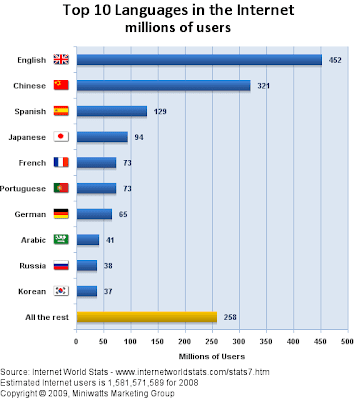
Example sentences
It is obvious that English was the most commonly spoken language by Internet users.
Unsurprisingly, the number of Chinese was also large.
The number of French and Portuguese users was exactly the same at 73 million each.
The number of Arabic, Russian and Korean users was similar, with 41, 38 and 37 million users respectively.
Korean was the least common language spoken by users.
It is interesting to note that six out of the top ten languages were European, while three were Asian.
There is too much information! I really don’t know what to choose!
If there are a lot of things being compared in the graph, or the information is complex, then you will need to group the information. Here are some ideas:
|
Types of things being compared
|
Possible groupings
|
|
sports / leisure activities
|
dangerous / safe
indoor / outdoor
social / solitary
|
|
countries / languages / people
|
Western / Eastern
rich / poor
developed / developing
small / large
|
|
energy
|
fossil fuels / renewable fuels
polluting / clean
|
|
transport
|
public / private
|
Look at this example from the Economist magazine.
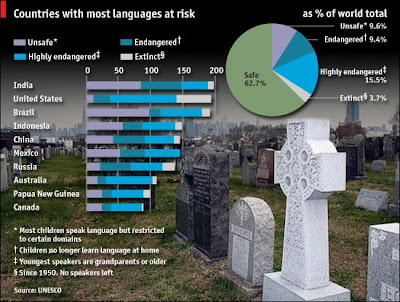
Divide the countries into developed and developing. You will a see general pattern:
Generally speaking, developed countries have larger proportion of endangered, highly endangered and extinct languages.
Look at the size of the countries:
With the exception of Papua New Guinea, all the countries are fairly large.
Tip Summary:
- Look for the six features
- Group information. (Also good for writing introductions!)
訂閱:
文章 (Atom)